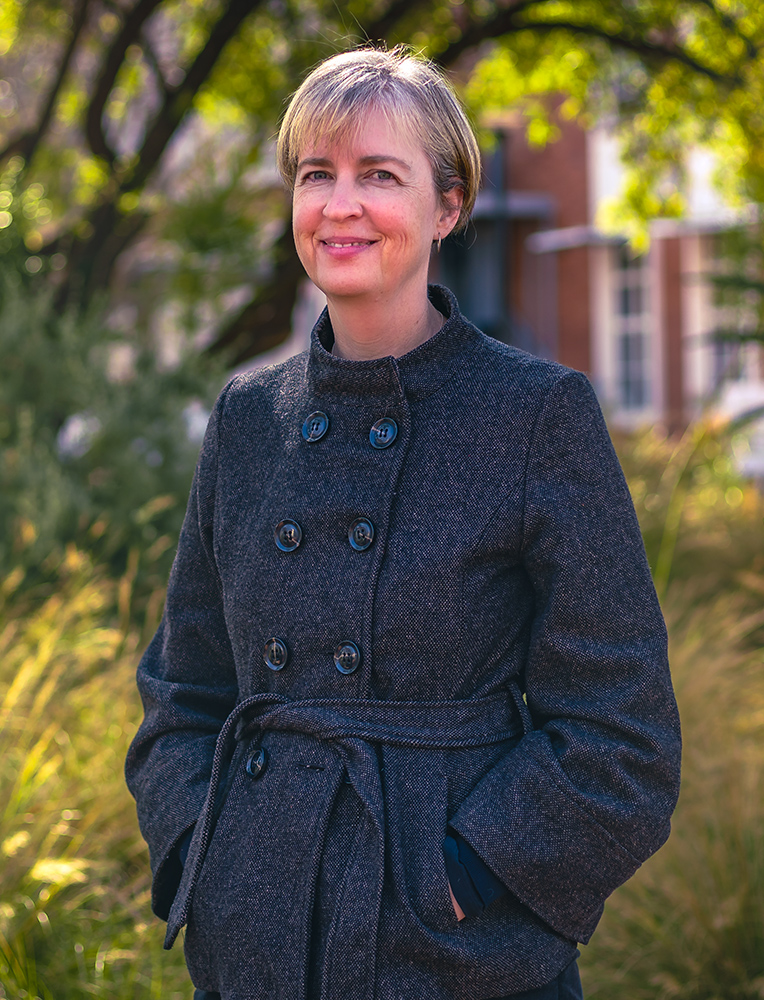

To breathe is to draw vitality from our atmospheric interdependence with others. This vitality derives first and foremost from the photosynthesising capacities of plants. Without plants, our planetary atmospheres would have remained hostile to human life. It is this foundational debt to plants that informs the current research of Prof Helene Strauss from the Department of English at the University of the Free State (UFS).
The World Health Organization estimates that 99% of people on Earth currently breathe unsafe air, resulting in as many as seven million premature deaths a year. A core premise of Prof Strauss’s research is that dirty air is a direct result of colonial modernity’s disregard for the carbon-sequestering labour of plants. She asserts that the unchecked scale and speed at which fossil fuel capitalism releases carbon captured in deep time into the Earth’s atmosphere, not to mention the rampant destruction of vegetal life to meet contemporary consumer demand, require that we attend anew to the life-giving symbiosis linking plant and human breath.
Working alongside scholars in the decolonial eco-humanities, Prof Strauss considers specifically how literary and other creative cultural texts imagine conditions for the flourishing of multi-species breath. She identifies in the work of artists, creative writers, filmmakers, and environmental activists particularly generative pathways towards repairing the foundational kinship relationship between human and more-than-human forms of living and breathing.
As the recent recipient of fellowships from the Stellenbosch Institute of Advanced Studies as well as the Institute for Cultural Inquiry in Berlin, Germany, in support of this research, Prof Strauss is particularly well-placed to delve into these vital concerns for our times.
The depletion of forests, together with the alarming rate of species extinction, not only put achieving Sustainable Development Goal 15 at risk, but more importantly it jeopardises the delicate balance of ecosystems. This goal seeks to protect, restore and promote sustainable use of terrestrial ecosystems, sustainably manage forests, combat desertification, and halt and reverse land degradation and biodiversity loss.
The topic of breath has preoccupied scholars of decolonial justice for many years. Prof Strauss’s research in this field grows in part from her award-winning book Wayward Feeling: Audiovisual Culture and Aesthetic Activism in Post-Rainbow South Africa ISBN 978-1-4875-4058-6, University of Toronto Press, in which the breath started to materialise as a central site of analysis. In this book, the search for breathable atmospheres emerged particularly in relation to South African histories of resource extraction, racial capitalism and violent patriarchy. The breath here indexed both the aesthetics and materiality of injustice as a socially-embedded mode of embodied experience.
Atmospheric injustice is at the root also of an accelerating climate crisis, additionally compelling scholars to take a closer look at extractive capitalism’s historically harmful relationship with air and lungs. In South Africa, mineworkers have long paid for the extraction of diamonds, gold and other mineral resources with their pulmonary health. Hazardous dust has been a debilitating threat to these workers long before recent airborne emergencies such as the COVID-19 pandemic started to constrain breath. Several of Prof Strauss’s recent publications, including a chapter in the book Ruptured Commons (edited by the Canadian scholars Veronica Austen and Anna Guttman), have charted the experiential histories of South African mining through this harrowing legacy of respiratory risk.
Polluted air has also emerged as a key site of social struggle for communities, for instance, in the Mpumalanga Highveld area, where citizens have long been breathing air that far exceeds the limits for particulate pollution stipulated by South Africa’s own National Ambient Air Quality Standards set under the National Air Quality Act. The 2022 outcome in the landmark #DeadlyAir case set an important precedent in this struggle, as it was the first to hold the South African government to account for breaching the constitutional rights of citizens to healthy air.
Prof Strauss’s research explicitly links the struggle over clean air to capitalism’s ongoing destruction of vegetal life. Alongside scholars of black, indigenous and feminist social and ecological relations, she insists that we must attend to the central link between plant respiration and human breath, and to the importance of heeding the lessons taught by plants as the original engineers of our planetary atmosphere.
Thinking and breathing with plants bring together a complex set of intersections and scholarly fields. Most prominent amongst these is the growing body of work in the environmental and energy humanities associated with the so-called atmospheric and vegetal turns. Prof Strauss enters these fields specifically through the prism of the phytosphere, a term that she expands from its traditional usage by plant scientists to include the terrain where plant chemistry sustains human and more-than-human breath.
The atmospheric relationship between plants and human breathing is thoroughly immersive and, ideally, mutually regenerative. The mass production of plastic and other forms of waste as the disavowed bedrock of extractive capitalism has, however, severely compromised the atmosphere’s biogeochemical cycles of repair. Building on recent as well as older African, indigenous and decolonial insight into what cultural theorist Hsuan Hsu calls the “material and spiritual qualities of air”, Prof Strauss seeks to analyse and amplify the work of creative cultural workers – including novelists, artists, filmmakers, and poets – who have drawn our attention to the regenerative capacities of plants. These capacities include the work that plants do to (re)oxygenate the atmosphere, to extract harmful particulate matter from air, to regulate temperature and water cycles, and to remediate damaged soil.
To this end, she is currently writing a book titled Phytospheric Justice, which brings together imaginative archives across a range of global sites that offer plant-oriented alternatives to fossil fuel capitalism’s chokehold on the Earth’s atmosphere. The book draws momentum from a recent explosion of popular interest in so-called plant sentience and vegetal intelligence. Much of this work has traced plant communication via the mycorrhizal networks connecting the popularly termed ‘wood-wide web’. While these networks are a central part of the complex ecosystem contributing to the health of the biosphere, Prof Strauss has been paying attention more closely to the exchange of air-borne chemicals made possible by plants, and to the remedial capacities of vegetal life as far as polluted air is concerned.
One of the most consequential insights to develop from this research is that petro-capitalist modernity has made both humans and plants companions in colonial histories of harm. Far from reading plants as straightforward saviours in the fight for risk-free air, in other words, Prof Strauss insists that we consider the complex set of biopolitical relationships that made plants key protagonists in histories of both colonial violence and decolonial repair.
What she refers to as ‘decolonial and feminist phytospherics’ emerge particularly through her analysis of literary and other creative audio-visual cultural production alongside several past and present environmental justice movements, including the South African #LivingLimpopo Campaign, the Green Belt Movement and Green Generation Initiative in Kenya, the Africa-wide Great Green Wall Initiative, the Chipko Movement in India, as well as ongoing Indigenous activisms against the tar sands in Canada, widely considered to be the most destructive fossil fuel operation in the world.
As a cultural theorist whose work has spanned the terrains of literary studies, film theory, aesthetics and activism, Prof Strauss is concerned especially with writers and artists who imagine worlds beyond petrochemical pollution and deforestation, and who make these imaginaries available to activism and human understanding beyond the often-inaccessible registers of climate science.
This research has also become a touchstone for Prof Strauss’s work in the classroom, where she has spent many years developing methods of embodied pedagogy aimed at curbing the crisis of attention currently plaguing digitally-distracted students the world over. In an honours course titled “Reading, Breathing, and Sensing with Plants” on offer in the Department of English since the start of 2025, for instance, as well as in a third-year seminar on the literary links between psychic and environmental health, she makes somatic-sensorial activities designed to forge partnerships between people and plants a central component of the learning process.
Given the centrality of vegetal life to these courses, they have offered fertile ground for bringing the growing international field of decolonial embodied pedagogy to life in the local South African classroom through the prism of phytochemical interdependence. She conceives of the work of multi-species breathing in these courses in part as exercises in unlearning, aimed at helping students release some of the pressures deposited in their bodies by the pursuit of higher education in a context of extreme material hardship and food insecurity, not to mention the daily stresses that come, for many, as first-generation students.
These pedagogical innovations grow in part from Prof Strauss’s ongoing involvement with several international research networks. Most recently, she drew inspiration for rethinking dominant approaches to pedagogy in South African higher education from her membership in the international “Reworlding Research Collective”, a group of academics, artists, and activists in Canada, Brazil, and South Africa who have sought to challenge forms of humanistic inquiry historically complicit with extractive and ecocidal systems of domination. One of the offshoots of this work has been a Special Issue of the journal Studies in Social Justice on the topic of Reckoning, Repairing, Reworlding that she co-edited, and for which she co-authored three essays.