
Health experts and the World Health Organization (WHO) agree that the world was not prepared, and is perhaps still not prepared, for the outbreak of the coronavirus (COVID-19) pandemic. Along with this, the risk of new health emergencies also continues to increase. In an effort to better prepare and respond to future health emergencies, Dr Tedros A Ghebreyesus, WHO Director-General, proposed a technical document titled, Strengthening the global architecture for health emergency prevention, preparedness, response and resilience (HEPR). This paper provides a two-part summary of the initiatives that are now under way to strengthen the global HEPR architecture.
The WHO developed the Global genomic surveillance strategy for pathogens with pandemic and epidemic potential, 2022–2032. The strategy provides a high-level unifying framework to leverage existing capacities, address barriers and strengthen the use of genomic surveillance in the detection, monitoring and response to public health threats.
According to the strategy, the continuous detection, monitoring and assessment of existing and emerging pathogens has become a global priority. The strategy builds on the lessons of the past, including the COVID-19 pandemic, while thinking ahead to safeguard the health and well-being of human populations. It provides a unifying vision for strengthening and using genomic surveillance capacities in local to global pandemic and epidemic preparedness and response. Countries are at the heart of the strategy. The strategy builds on existing strengths and encourages partnerships to ensure that genomics is part of our 21st century surveillance toolbox for a post-COVID world.
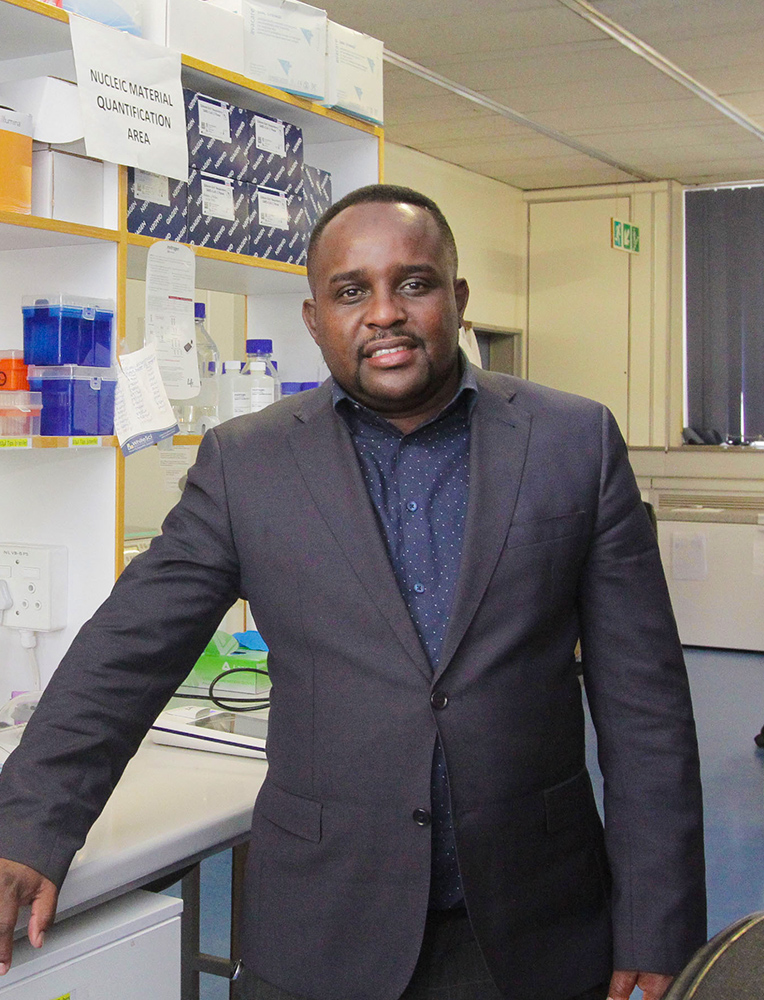
Prof Martin Nyaga, Head of the University of the Free State–Next Generation Sequencing (UFSNGS) Unit and Professor of Virology, undertakes research which primarily revolves around pathogen genomics, leveraging cutting-edge Next-Generation Sequencing (NGS) technologies for comprehensive pathogen surveillance and characterisation, plays a key role in this strategy. His research involves delving deep into the genetic makeup of various pathogens, particularly viruses of significant public health concern, to understand their evolution, transmission dynamics, and resistance patterns. His team focuses on the entire spectrum of the genomic process, from meticulous sample preparation to library construction, sequencing and data analysis.
The core of their exhilaration stems from the unparalleled resolution and speed that NGS brings to the investigation of viral pathogens. Traditional methods often provide only a snapshot, but genomics allows for the observation of viruses in unprecedented detail, almost in real time. This includes identifying novel viral strains, tracing the origin and spread of outbreaks, and even predicting potential mutations that could impact vaccine efficacy or drug resistance. For example, Prof Nyaga and the team’s work is crucial in monitoring vaccine-preventable diseases (VPDs), aligning with his role as Director of the WHO Collaborating Centre for VPD Surveillance and Pathogen Genomics. The ability to rapidly sequence and analyse viral genomes means they can provide critical data to public health authorities much faster than ever before, enabling swifter and more targeted interventions.
Globally, Group A rotaviruses (RVA) represent the most common cause of paediatric gastroenteritis in children under the age of five. There has been an increase in global detection and reported cases of acute gastroenteritis mostly caused by RVA genotypes G1P[8], G2[4], G3[8], G9[8] and G12[8] strains, with more severe disease reported particularly in Africa. In the research article, Genomic Analysis of Rwandan G9P[8] Rotavirus Strains Pre- and Post-RotaTeq® Vaccine Reveals Significant Distinct Sub-Clustering in a Post-Vaccination Cohort published in Viruses, Prof Nyaga and colleagues assess changes in the evolution of the genomic makeup of the G9P[8] strains that were circulating in Rwanda during the pre- and post-RotaTeq® vaccination periods, as part of the WHO CC disease surveillance at whole genome level in Africa. The researcher’s findings indicate that the Rwandan G9P[8] strains revealed a distinct sub-clustering pattern among post-vaccination 2015 study strains circulating in Rwanda, with changes at neutralisation epitopes, which may play a role in neutralisation escape mutants from the vaccine candidate in use in Rwanda for these strains. This emphasised the need for continuous whole-genome surveillance to better understand the evolution and epidemiology of the G9P[8] strains post-vaccination, and to further assess the vaccine’s impact on circulating rotavirus strains in Rwanda.
What makes this field so profoundly exciting is its direct relevance to global health security. In an era of increasing interconnectedness and emergent infectious diseases, understanding the genetic blueprint of pathogens is not merely academic; it is foundational to defence. Every genomic sequence they generate contributes to a larger global knowledge base, allowing for a collective, informed response to viral threats. This dynamic interplay between cutting-edge technology and immediate public health imperative is what drives our research forward with passion and purpose.
The impact of pathogen genomics research on society is profound and multifaceted, extending from localised public health interventions to global health strategies. Primarily, the UFS-NGS’s work provides the foundational intelligence needed for robust public-health decision-making. By rapidly identifying and characterising circulating viral strains, we equip health authorities with the data necessary to implement targeted control measures, allocate resources effectively, and communicate accurate information to the public during outbreaks. This early warning capability is critical for preventing widespread transmission and minimising morbidity and mortality. For instance, The African Enteric Viruses Genome Initiative (AEVGI), which Prof Nyaga co-founded, improves rotavirus vaccine efficacy across five African countries, potentially saving numerous lives. During the COVID-19 pandemic, their work with the Network for Genomics Surveillance in South Africa (NGS-SA) provided critical data for policy and vaccine rollouts, demonstrating immediate benefits.
Beyond immediate public health crises, the UFS-NGS Unit research contributes to strengthening health care infrastructure and capacity building, particularly within South Africa and the broader African continent. They are not just generating data; but are building expertise, training the next generation of scientists, and establishing state-of-the-art diagnostic and surveillance capabilities that will serve our communities for decades to come. The technical proficiency and ability to follow complex protocols with precision, exemplified by the team, are direct outcomes of this commitment to capacity development.
Ultimately, the societal impact of their research can be seen in enhanced public safety and improved quality of life. By reducing the burden of infectious diseases, they free up health care resources, reduce economic disruption, and foster healthier, more resilient communities. Their work empowers policymakers, clinicians, and individuals with the knowledge to make informed choices, moving us closer to a future where pandemics are better controlled, and preventable diseases become a relic of the past.
Prof Nyaga plans to strategically align advancing the UFS-NGS capabilities in pathogen genomics and amplifying their societal impact. The immediate horizon involves expanding their research into a broader spectrum of pathogens, including those associated with neglected tropical diseases, and exploring host-pathogen interactions at a genomic level. A significant pillar of their future planning is the integration of advanced computational and artificial intelligence (AI) methodologies for genomic data analysis. While the current work of the UFS-NGS emphasises experimental design and data capturing, the sheer volume and complexity of NGS data demands sophisticated bioinformatics pipelines and machine learning algorithms. The unit aims to develop predictive models for viral evolution and transmission, allowing for even more proactive public health interventions. This will involve investing in high-performance computing infrastructure and recruiting specialised bioinformatics expertise.