
The world is rapidly becoming more urbanised with more than half of all people living in cities. The United Nations (UN) predicts that within the next five years, urban areas will be home to 60% of the global population, with one in every three people living in cities. According to the 2018 Revision of the World Urbanization Prospects, a report by the Population Division of the UN Department of Economic and Social Affairs, the global urban population is projected to grow by 2.5 billion urban dwellers between 2018 and 2050.
According to the Africa Urban Forum, urbanisation on the African continent represents a megatrend. By 2050, the percentage of people living in urban areas is predicted to rise from 47% in 2000 to around 60%. With an average annual urban growth rate of 3.5% in the past 20 years, Africa has seen the largest urbanisation in the developing world, and this trend is anticipated to continue until the year 2050. The Africa Urban Forum is a continental platform established by the African Union (AU) Commission and its member-states in response to the rising consciousness of the rapid urbanisation in Africa. It promotes sustainable development in African human settlements.
Affording housing, according to the Sustainable Development Goals Report 2025, has become a crisis for most people as up to three billion people struggle to afford a place to live. A further 1.12 billion live in slums or informal settlements without basic services. To address the mounting challenges cities face, including rising urban poverty amongst others, the UN SDG 11 through target 11.1, aims to ensure access to adequate, safe and affordable housing and basic services for all and upgrade slums.
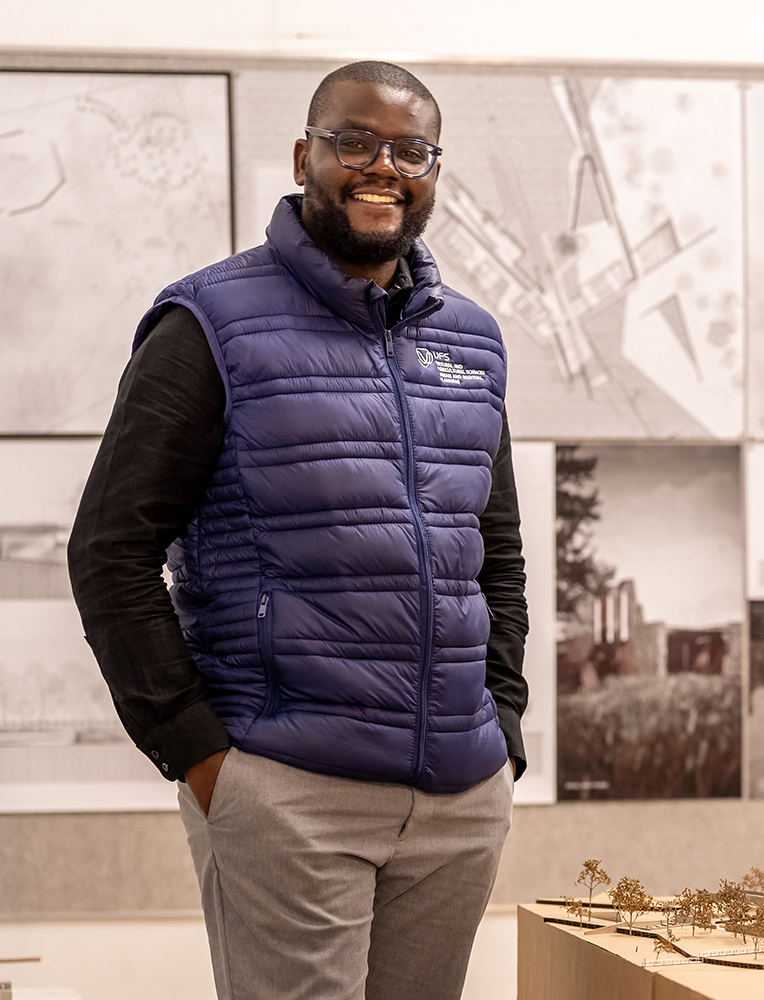
Prof Abraham R Matamanda, Associate Professor in the Department of Urban and Regional Planning at the University of the Free State (UFS), seeks to address issues of spatial inequalities through understanding the lived experiences of individuals and communities residing in marginal spaces. In this regard, his work has focused on citizens’ access to basic services such as water, sanitation and food in cities. Spatial inequalities are a reality in most southern African cities; these inequalities are exacerbated by multiple factors, including poor urban governance, corruption, civil unrest, environmental stressors such as climate change, and pandemics such as COVID-19. These challenges call for a robust urban planning policy that seeks to redress the inequalities and provide inclusive urban policies that help marginalised individuals and communities to access a better quality of life in cities.
In a research article titled, Small-scale rental housing in Southern Africa: from neglect to nurture? published in Housing and Society and which speaks directly to SDG 11, Profs Matamanda, Andreas Scheba, Associate Professor, Centre for Development Support, UFS, and Ivan Turok, who holds the Research Chair in City-Region Economies in the Faculty of Economic and Management Sciences at the UFS, argue that most governments and related stakeholders in southern Africa fail to recognise the contribution of small-scale rental housing (SSRH) to national housing systems and solutions. They also illustrate how national housing policies, regulatory frameworks and institutions are unfit for purpose, and how they can do more harm than good. In the Global South, they write, the growth of private rented accommodation tends to take the form of SSRH provided by individual homeowners and micro-developers. This has played a vital role in mitigating urban housing shortages, enabling access to the city for low- and middle-income households, and bolstering local economies. Yet, this largely informal and unplanned phenomenon also creates health and safety risks for tenants, mounting pressure on public infrastructure, and shortfalls in municipal revenue collection from the economic value created.
In 2022, Prof Matamanda was the primary investigator for a project exploring the impact of COVID-19 on young people in low-income households and their adaptations to food, education and leisure/play during the COVID-19 lockdown. This was an international collaborative project with researchers from South Africa, Brazil and the UK. The PANEX-Youth research project titled, The Impact of COVID-19 on Education, Food & Play/Leisure and Related Adaptations for Children and Young People: International Overview, provided many lessons and insights into the lived experiences of young people and their adaptations to the COVID-19 pandemic. Specifically, this project has revealed the policy gaps in dealing with pandemics and how young people are not integrated into policymaking. The voices of the youth remain silenced, and policymakers seem to ignore or overlook the needs and aspirations of this demographic group, yet the youth constitute a large share of South Africa’s population, illustrating the continuing trend of how these young people are left behind in socio-economic and development processes.
As a result of this project, the team has collaborated with UNICEF to produce a call to action that advocates for youth participation in urban policy making, inclusive decisions and governance that recognise the needs and aspirations of young people and the emphasis on social networks and capital in community development. Additionally, a working paper has been developed in collaboration with UNESCO, illustrating the role of schools as critical hubs in urban areas, through which young people not only access education but also access care, food, leisure/play and peer support. Hence, Prof Matamanda’s work helps in understanding the socio-spatial inequalities and realities, thus providing policy insights through identifying the policy and practical gaps, guiding inclusive and participatory planning, which can help to promote social cohesion and reduce inequalities.
The second strand of his work has focused on land governance and development outcomes in Southern African cities. Land is a largely contested and politicised issue in Southern African countries. Access to land, especially for housing development, is largely challenging for many urbanites due to land grabs by economic and political elites, weak disconnected land governance systems that fail to address local realities, and the limited supply against an ever-increasing demand for land. As such, Prof Matamanda’s research has explored the land governance in selected Southern African cities with a focus on how migrants, youth, women and low-income households access land for housing. His work is significant for SDG 11 as it addresses issues around land governance systems and institutions that regulate urban land markets and the policy gaps that hinder the efficient distribution of land in these cities.
Over the years, he has collaborated with local and international scholars and researchers to examine the land governance dynamics in peri-urban areas. His work on land governance contributes to improved urban planning and governance through understanding the processes and impacts of urban land governance on sustainable urban development. Moreover, the work provides policy insights and helps shape land governance. Going forward, Prof Matamanda is extending his work into small urban areas, with a particular focus on spatial governance and planning of mining towns. This is a fundamental issue in Southern Africa, considering the complexities associated with mine closures and how many countries do not have mine closure plans, which complicates the normalisation processes.
Another aspect of Prof Matamanda’s work related to SDG 11 is situated around housing and human settlements studies, in which he explores housing as a complex challenge in Southern African countries. The focus of his work has been on informal settlements and SSRH. Housing is a crucial issue in African cities, where national governments are struggling to provide adequate housing to most citizens, and the national housing shortage continues to increase. The situation is dire for low-income households who are forced to reside in horrendous accommodations, often compromising their health and well-being. The financialisation of housing exacerbates the situation as many households fail to afford the cost of buying homes and end up residing in informal settlements or rental accommodation.
Here, he also collaborates with Profs Scheba and Turok, on an innovative research programme focused on SSRH, with significant work undertaken across Southern Africa. This collaboration has resulted in a number of benefits, with the most recent impact being a major amendment to the Cape Town municipal planning bylaw, which minimised the regulations and building standards required for micro-developers to apply for land-use planning permission in designated areas.
In efforts to gain more insights and share experiences on the SSRH sector, Profs Matamanda and Scheba have established a network of urban researchers across Southern Africa to undertake a comparative analysis of this important phenomenon in South Africa, Zimbabwe, Angola, Botswana, Lesotho, Eswatini and Namibia. The network includes researchers, policymakers and NGOs working in the housing sector. Prof Matamanda is also working with Prof Daniel Kweku Baah Inkoom from Kwame Nkrumah University of Science and Technology in Ghana, Prof Alonso Ayala from the Institute for Housing and Development Studies, Erasmus University Rotterdam, the Netherlands, and Prof Tamara Klicek from National Taipei University, Taiwan. The team is tackling the knowledge and policy gap on land governance and SSRH, while also strengthening the regionalisation and internationalisation agenda emphasised by the UFS.